My Placement on a Clydesdale Farm

I’ve been spending the majority of my summer vacation at home in Canada. It was nice to have my long break over the Christmas period. While at home I have been working full time and am just starting to complete some placements again. This past week I was working on a Clydesdale horse farm. I was very excited for this placement because I have never worked on a horse farm before. Riding is one of my favorite things though! For those who don’t know, Clydesdales are large draft horses used for work such as pulling sleds/sleighs. This farm was training and breaking horses to be sold as work horses or be taken to shows and compete.
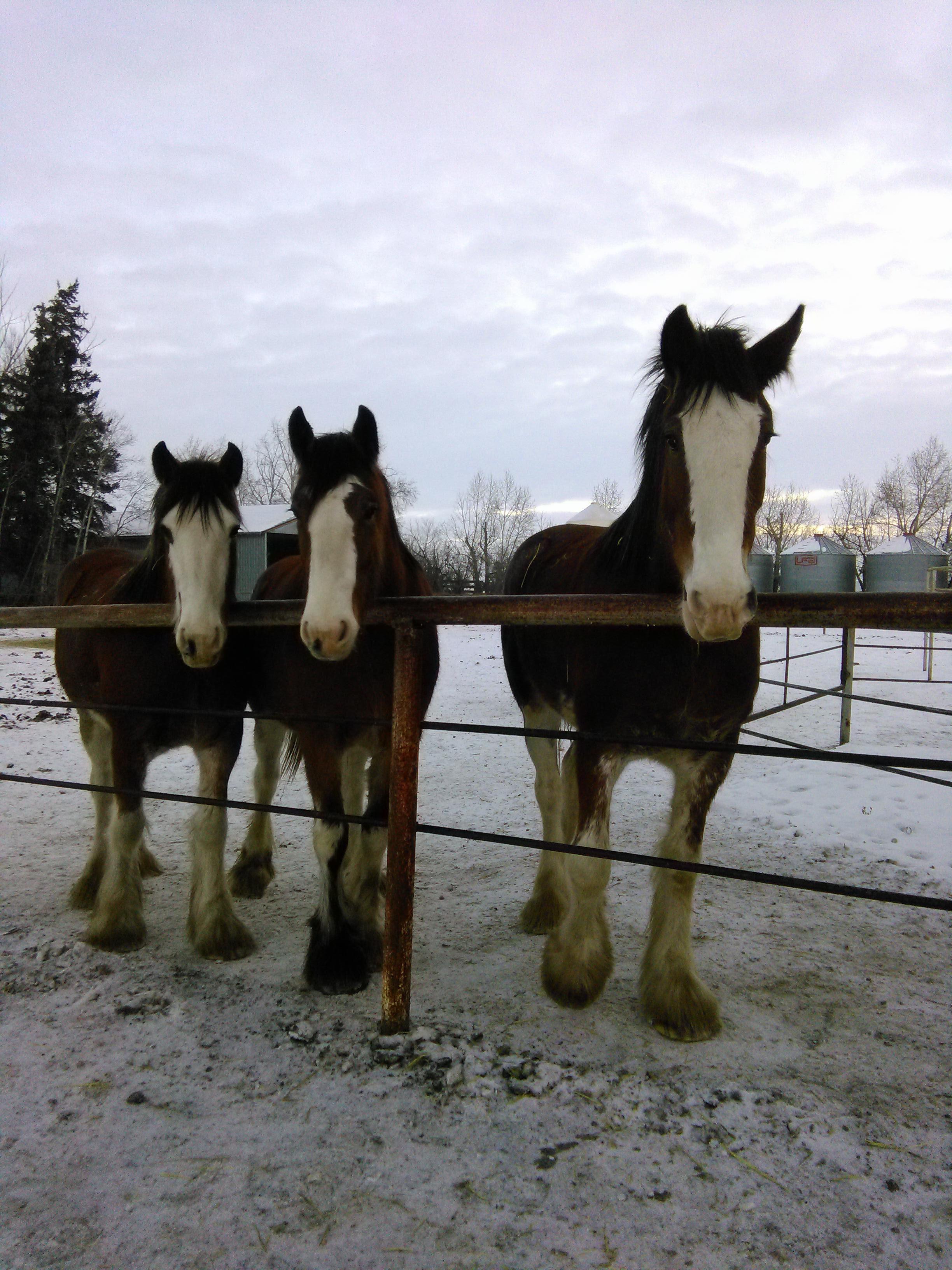
WP_20160112_002

These horses tower above me! Most of the horses on the farm were over 17 hands high.

Each morning started by hooking up a 2 horse team to the sled. We tried to pair a more experienced driving horse with an unbroken horse. The more experienced horse would lead the other. While on the sled we taught the horses to follow commands such as stop, start, step forward one step, back up, stop at the gate, hold head up, etc. I even got to take the reigns into my own hands once or twice!
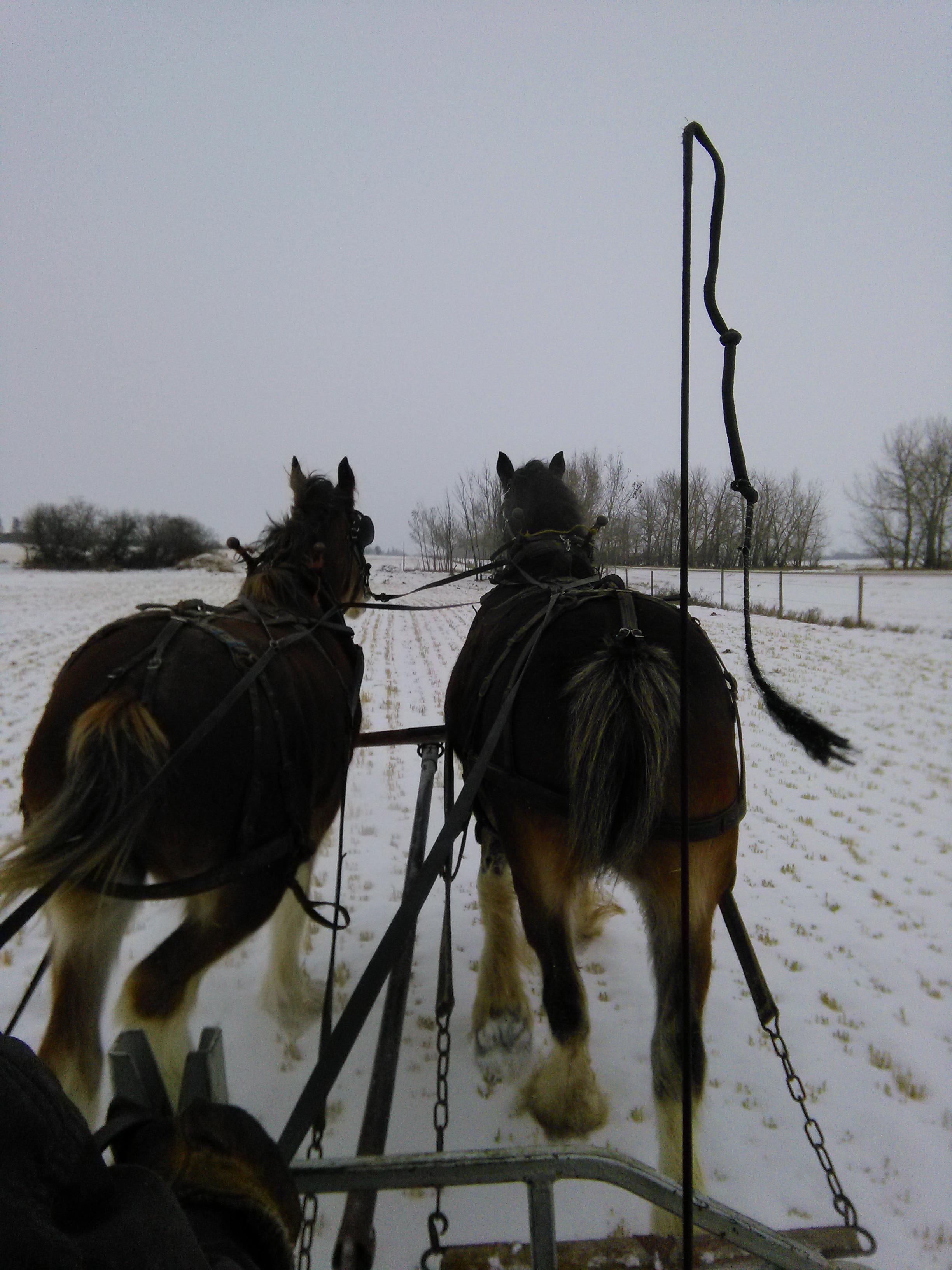
WP_20160114_003

Some years the snow is so deep that the sled is harder to pull. Pretty easy pulling for these horses this winter!

One very interesting thing we also did was something called ‘donkey-breaking.’ I had heard of this happening with cattle previously but had never had the opportunity to experience it. If an unbroken horse needs to be halter trained (trained to be lead around and walk calmly with a head halter on) they can be harnessed to a donkey. The donkey is very strong and stubborn and will lead the horse around a field and get it used to the sensation.
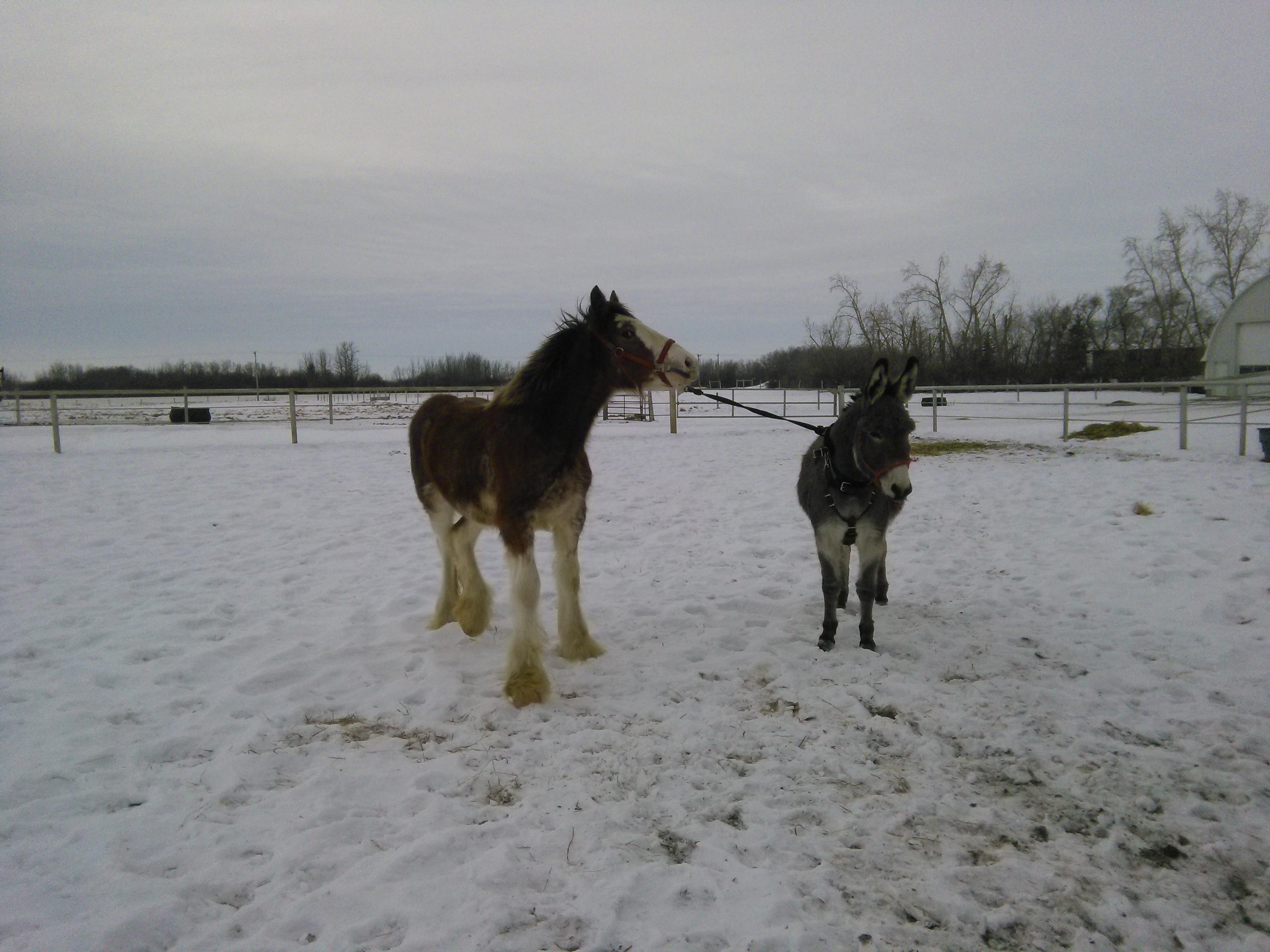
WP_20160113_009

This stubborn donkey will begin to teach this filly to be led around by her halter and a lead rope.

On another day I was working with an unbroken filly getting her used to the sensation of touch. I spent some time standing a few feet away from her and literally sweeping her with a broom. This action will get the horse used to touch without putting myself in too much danger from being too close to the horse. After working with this filly she was ready for her vet check in the afternoon; which included a blood draw for Coggins testing. Coggins looks for Equine Infectious Anemia (EIA) which is needed to be evaluated before horses are taken to shows or exported.
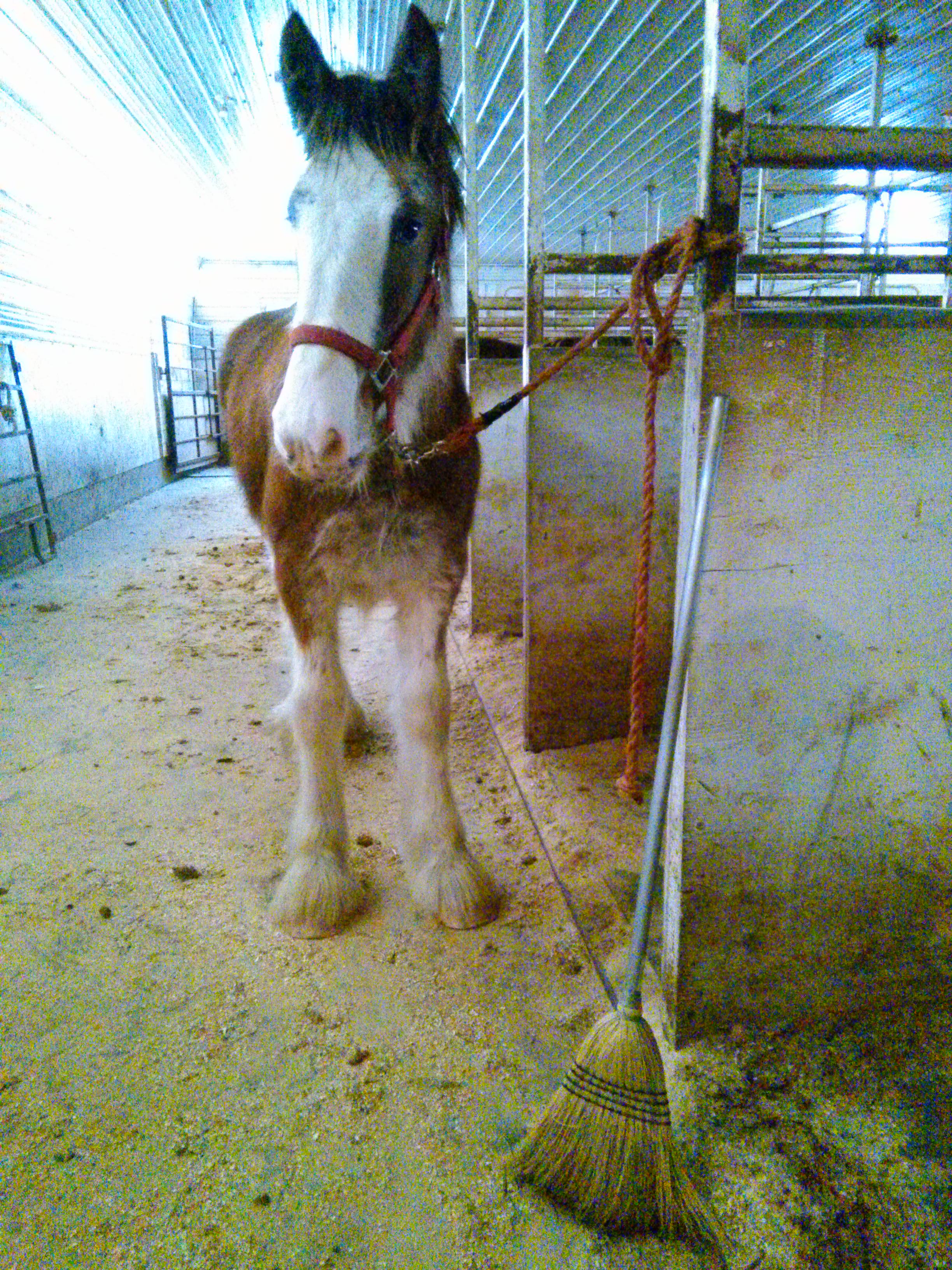
WP_20160114_026

The filly feeling unsure about the nearby broom.

I spent the rest of my time on the farm helping with other odd farm jobs, mucking out stalls, moving horses, etc. I even visited a nearby elk farm that belong to a family member. This elk farm was very interesting to see after my last placement at a different elk ranch in July.
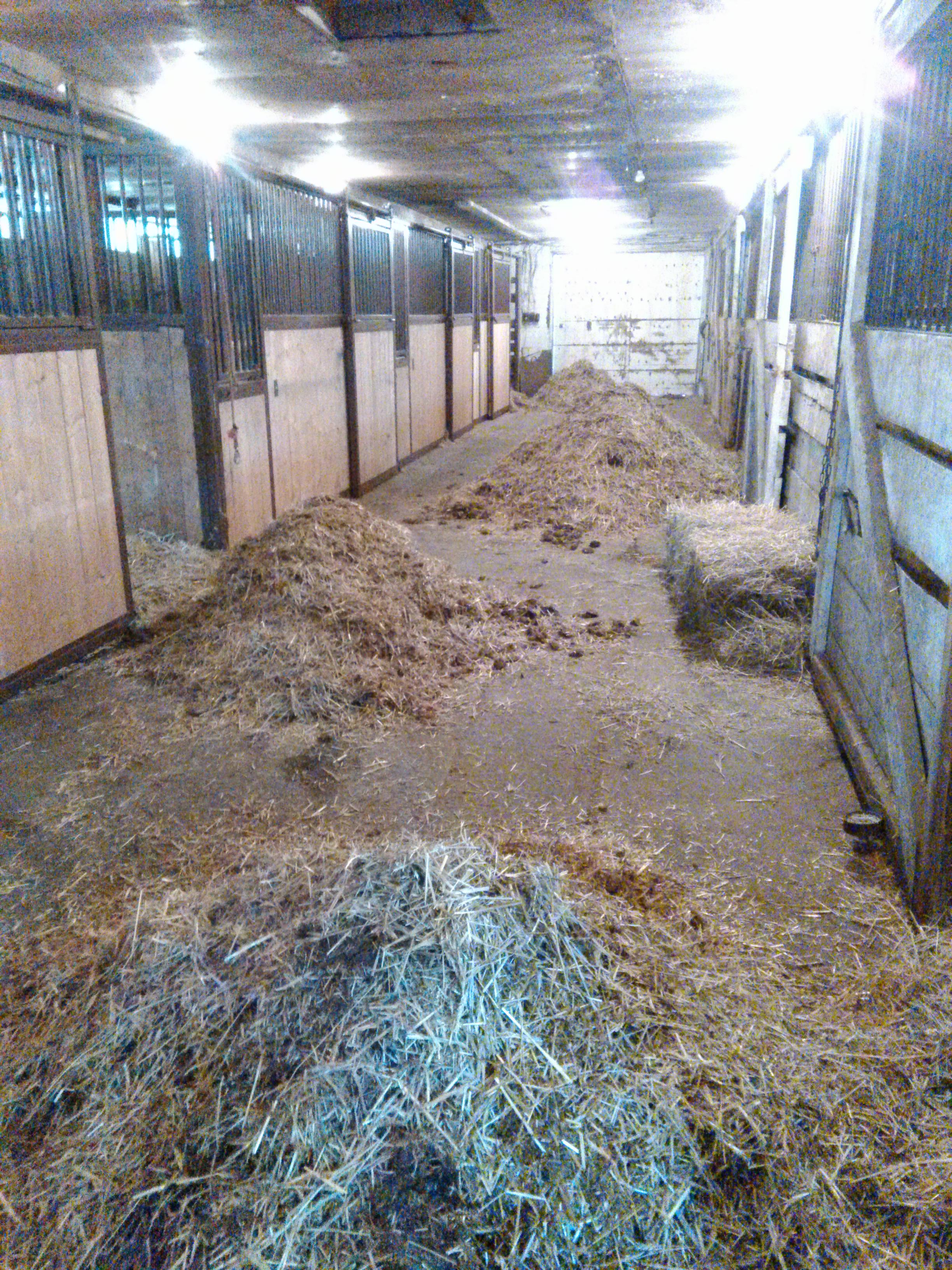
WP_20160114_039

Mucking out large Clydesdale stalls is a lot more work than regular sized horses!

Thank you so much to my family and friends who have been working their connections and helping to set up these placements and opportunities to me.  Sending endless appreciation to the placements who treat me like family during my time with them.  🙂

8 steps to having a good first year in vet

With the end of my first year of veterinary medicine finally coming to a close it seemed fitting to share 8 steps I used to help me have the best first year of vet school!

Don’t work too hard 

  • Hard work is amazing. Never run away from hard work; you get out of it what you put into it. You’ll need to study, memorize, practice, learn every day in vet school. But I hear classes only get harder and the schedule gets busier, so don’t destroy yourself in first year trying to keep up.


Make sure you make good friends with lots of people

  • One day these friends will turn into co-workers! For right now they are study buddies, best friends, network contacts, etc. University days are supposed to be the best days of your life–and good friends help with that!

Get involved with clubs, exec, off campus activities

  • This was something I did in my undergrad degree and it generated a lot of favourite memories. Becoming a part of a club or team will allow you to get to know people better and make more friends. I also found it really important to have friends outside of vet.

Get to know your profs quickly

  • Believe me, this will help when it comes to networking or studying, or feeling like you belong. You can be friends with your profs! If a professor knows who you are they will better be able to answer questions or frustrations you may send them while studying; they’ll also be more willing to offer up industry contacts or experience.


Don’t share your grades with friends

  • This might not be helpful for you, but for me–I’m ridiculously competitive. By not sharing my grades with other people I’m keeping my stress levels down. I’m working hard on studying, getting grades that I’m satisfied with and not constantly trying to outdo everyone just for the fun of it (this has made for a much more relaxing school year).


Change your study habits

  • I have found that there is a lot of students who have entered vet without an appropriate study technique. These students definitely need to speak to other classmates and professors to find the best way to learn material. I was confident in my study habits, but I changed some of them up for something new —it gets a bit boring when you’ve been studying the same way for 5 or 6 years. It is also important to recognize that different classes may need to be studied for in different ways. Example: class A would be great to learn via flash cards; class B would be great to learn via straight memorization; class C would be great to learn by drawing out flow charts, time-lines, and summaries.

Keep your doors open

  • So many students come in to vet knowing that they want to do cats and dogs or large animals. (Right now I want to do large animals when I graduate!) However, I think that everyone should embrace the wide range of knowledge and opportunities gifted to us in school. Try and learn about all animals and don’t discount something because you do not believe you’ll ever work in that field. The amount of vets who graduated and then completely changed their area of interest is huge!


Never forget where you are!

  • In case you didn’t notice: YOU ARE IN VET SCHOOL. How hard was it to get here? How long have you been working for this? Would you want to do anything else with your life? When exams and papers and lower grades feel like they are piling up just remember that one day you’ll be a doctor (and that is a HUGE accomplishment)!

Last Day of DVM1

WOW! I love vet school so much! Today was simply amazing, not because it was my last day of lectures—but because of all the fun and interesting things that happened:

I came in before my class to help my roommate with a bake sale she planned to raise funds for the Australian Rhino Project. We baked 300 cupcakes and decorated them all and then sold them in front of the student’s union building. All of the proceeds are going to the Aus Rhino Project who is working to bring a breeding herd of rhinos to Aus as a conservation measure. There will be 80 rhinos brought over in the next 3 years. The bake sale was an idea inspired after listening to a completely engaging and terrifying lecture on the future of rhinos in Africa (and how close they drift towards extinction).

WP_20151023_004

I left the bake sale to go to a case study. This year we have 2 to 3 case studies a week (one for each class) that works to bring a lot of the learned concepts together. This case study was HUGE! It was complicated. And I understood…most of it…. (I might have to go home and review my notes again). The class worked through a dog that was brought into the clinic after being hit by a car. After looking at physical exam results, radiographs, ultrasounds, and blood gas analysis we determined that the dog had a pneumothorax and a uroabdomen.

Next was a practical class where we watched our professor artificially inflate a pair of sheep lungs to demonstrate ventilation/perfusion matching, pneumothorax, atelectasis, etc. It was very cool to see this instead of just reading about it.

Then I caught a quick tram ride to Melbourne Zoo where Zoos Victoria was hosting a Zoo Conservation Ethics/Welfare Q&A lecture with Jenny Gray and Peter Sandoe. The discussion was HUGELY stimulating, intellectually diverse, and even heated at times. We raised many complicated questions of best methods for zoos to work in conservation, culling, public education, and how to categorize zoo animals (are they wild animals? domesticated? tamed? companions?). By the end of 2 hours my brain was exhausted— but I couldn’t have asked for a better way to end my first year of DVM!! I can’t wait to see what my last day of DVM2 looks like 🙂

zoos-victoria_0

Now excuse me while I go hermit away and study for finals!

Subway Announces That a Bullet Is Their Treatment Of Choice For Sick Animals…

Anne's avatarFeed Yard Foodie

Tuesday, Subway restaurants made the announcement that beginning in March 2016 it will serve chicken raised without antibiotics. Further, the company will source turkey, pork and beef in the same manner within a 10 year period. A spokesman for Subway stated that company’s goal is “eliminating antibiotics from all of its meat supplies within 10 years”.

There are two different things going on in the above statement that are being blended into a mass of dramatic confusion. I want to take a moment to clarify so that everyone can be educated food purchasers.

  1. Eliminating antibiotics from meat has already been accomplished. THERE ARE NO ANTIBIOTICS IN THE MEAT THAT YOU EAT! It is illegal in the United States to market food animals that carry antibiotic residues. This is a non-negotiable fact of food production. The meat that you purchase from Subway today is free of antibiotics. That is the law…

View original post 596 more words