‘Watch me snip snip, watch me neuter’

I’m on my way back to Australia right now; sitting in LAX (my least favorite airport) and killing 9 hours.

Yesterday I finished off a 2 week placement at Tri-Municipal and Meridian vet clinics. They are a mixed animal practice–with the majority being small animal work.

Throughout the week I followed doctors into dog and cat consults. Often I would just listen but sometimes I was involved in the discussion of the case. I  also did my own physical exams and administered vaccines and dewormer to the patient.

Early in the first week I got a chance to try my hand at a cat neuter.  This is a relatively ‘easy’ surgery in small animal medicine—you still have to go to school for a lot of years to get to do it though!  There is a few different techniques and I wanted to try them all.

20180125_125935

I made sure to practice on this string with a knot in the end… I probably castrated it about 18 times. #poorstring

We diagnosed a textbook case of demodicosis.   This is a skin disease caused by a little mite that lives in the skin and can cause a dog to be itchy and lose patches of hair. You can find the mite by looking at a sample under the microscope. This was interesting for me because it is not an overly common disease. As well, quite often you can diagnose a patient with the disease without ever finding the little bug! This particular case presented an interesting opportunity for research to determine if this animal was safe to breed. There is a concern that this could be passed on to future puppies.

My favourite calls this week were the cattle calls. The first one turned out to be a bit of an emergency— we were called to a farm who had a cow with an episiotomy. Unfortunately the cow was bleeding out and the vet had to rush in and suture her up! I hear she is doing great!

We also went to a couple of small hobby farms to do some preg-checking. Yes, this is one of the times where vets stick their arm up cow butts to see what they can feel. It was nice to be on a small farm for these appointments because it allowed us to go a bit slower.  I palpated each cow after the vet and gave my own diagnosis of pregnant vs open (not pregnant).  You can diagnose this based on what the uterus feels like. I need more practice before I can really start being specific about weeks of gestation.

We went to a dairy and examined 4 sick cows. Two of them likely had pneumonia. This was interesting for me to see after my last placement where we did lots of post mortems on cows that had died of pneumonia. This week I got the chance to examine and observe clinical signs of pneumonia in live cows.

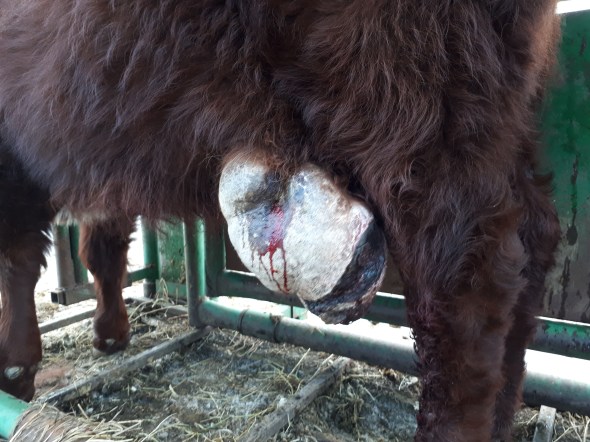
Abscess are pretty common in cows. And if you are one of those people that love ‘Dr. Pimple Popper’ then you will love cattle abscesses. So when we got a call about a ‘cow with a lump on it’ that is what we suspected. But, that was not quite the case….
20180118_153943

This is not an abscess, not an abscess at all.

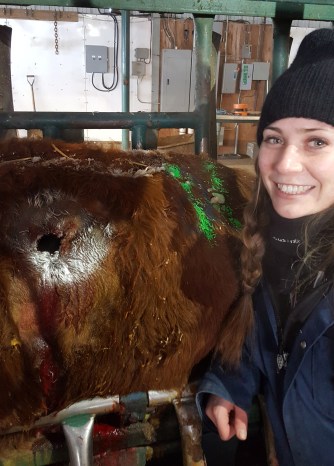
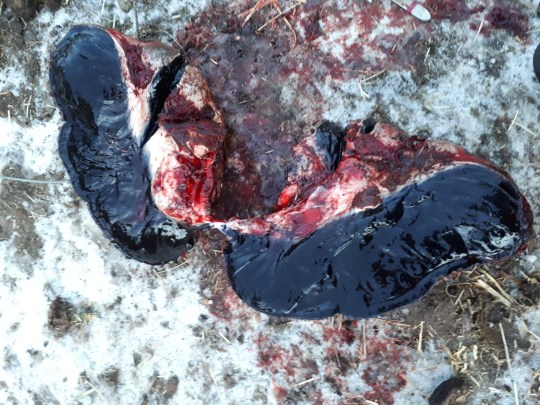
Instead we were presented with a really weird tumor hanging off the cow. It had appeared to have burst open then sealed and re-grown. We determined that it would be best to sedate the heifer for the removal procedure. We attempted IV sedation via the tail vein. Either we under-dosed or the heifer was just not having it—she got a bit loopy and angry but never sleepy enough for us to cast her. She paced at the end of her rope on the non-ideal side of the squeeze.  A bit of a rodeo ensued but eventually she was safely inside the squeeze again, and we infused the stalk of the tumor with a local anesthetic before removing it. The sun was going down and it felt like a bit of a race against time. When we finally had the tumor off I cut it open to see what it looked like inside (classic vet student… because this thing was gross!!).
20180118_165825_001

It was swollen and dark red inside. When you pressed on it a black liquid came off in my hand

The inside was really weird looking and my best guess is a hemangioma? Any other vet field friends have guesses as to what it could be?


I had been crossing my fingers and saying little prayers that we would get a calving call on one of my placements. It is a bit too early for lots of calving in Canada right now.  But we got a call for a c-section! Surgery was preformed in a fantastic and heated (yay) barn! with warm water and facilities—like a table! Everything went great and we had a live (large) calf at the end of it! We did a 2 layer closure on the uterus and a 3 muscle layer closure, then sub-cutaneous tissue, then skin. I definitely got my practice in with cattle sutures!

We had a few other interesting cases this week. One of them was a dog who could not pee. He is an adult dog but we suspect that he was born with an abnormality that prevents him from urinating. We took x-rays and he had a huge bladder! I catheterized it and drained a lot of urine for him! You could tell that he started feeling better by the minute. We hadn’t got to the bottom of the problem by the time my placement was over.

I also observed tail docking of some rottweiler puppies. This is quite the ethical/moral debate in the veterinary world.

Another interesting house call was to do puppy exams on German Shepherds (one of my favourite breeds!) at a breeder’s facility. This was a particularily cute….and wiggly exam day.

One morning we arrived to a severely sick scouring calf. We monitored vitals (heart rate, breathing rate, and temperature) and ran in warm IV fluids for a short while before heading off on a farm call. There was an older bull calf castration on the schedule that I wanted to watch.  The bull calf was a bilateral cryptorchid (inguinal crypts).  This means that his testicles were not fully descended and castrating him was not going to be as easy as we wanted it to be.  After putting in an epidural we got the job done on not 1, but 2 bull calves.

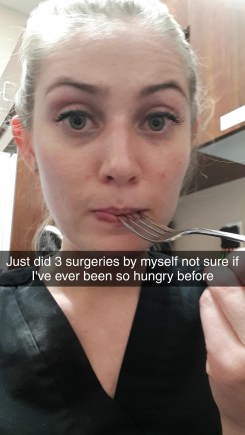
By the end of the second week I was lucky enough to have done a few feline spays, a couple of canine castrations, and a bunch of cat neuters on my own. I feel much more confident doing these surgeries by myself. I have yet to determine my own specific favorite method though—hopefully that will come during my de-sexing rotation in a few weeks time.
Snapchat-1788010203

So much focus and brain energy used. I also need to focus on not tensing up my shoulders during surgery.


After the last day of placement I said goodbye, and drove home in a beautiful snowfall to finish off my packing. Some of my friends stopped in to say goodbye which was lovely as well.

Thanks again to all the staff at Tri-Municipal and Meridian Vet Clinics! I had a great time!
 

Freezing Fingers & ‘Cutting Deads’

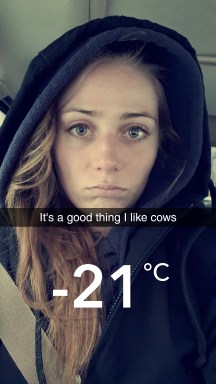
Its a balmy -10C outside today as I write this and think fondly back on my last week. I drove out to Calgary to work at Veterinary Agri-Health Services (VAHS), a practice that does a lot of feedlot work. They also service cow/calf operations. It was below -20C almost every day–what a way to kick off the year!

20180107_160822

It is not the best time for cattle work in Canada–a little too early for calving season which is usually in the early spring and can be quite busy. So my mornings at the practice were spent in the offices either helping with drug orders or studying. I sat in on a webinar about a new vaccine in Canada, attended a pathology presentation for feedlot workers, and listened to a presentation on Johnes disease in beef cattle from a previous summer student. I really enjoyed the discussion about that topic.

This practice is completely ‘ambulatory’ which means that farmers/producers will call the practice and the vet drives out to their farm (or feedlot) with all the equipment they need. All the exams, treatment, and surgery the vets do happen on the farm. So each afternoon I hopped in the truck with a vet and we headed out.

I worked with a couple of female vets this week. I really appreciated this experience as it allowed some conversation about how to survive as a female in the world of large animal vetting and agriculture. We discussed confidence, work/life balance, how to protect your body from breaking down, and how to pee when you haven’t seen a washroom in 100+km…

20180111_113801

I honestly have missed seeing that big Alberta sky, but that doesn’t leave a lot of spots for privacy…

Feedlot vets do a lot of post mortems (autopsies); while this might sound a bit morbid to some of you I actually quite enjoy them.  The colloquial term a lot of vets use is ‘cutting deads’. It is very exciting to be able to open up an animal and look at 1 or 2 organs and diagnose why the animal died. We did post mortems everyday– they aren’t easy work but it will keep you warm outside!  Its not the safest work either—when you can’t feel your hands and your standing on ice—it just takes a few tries to learn some of the tricks! At the beginning of the week I struggled with finding where to put my knife and remembering all my respiratory pathology from first year–by the end of the week I felt a lot more confident about what I was doing and what I was seeing. But I’m sure I’ll be getting a lot more practice with this.

Snapchat-1374610356

Twice this week we looked at some cattle for export. This means that they are being transported across the border from Canada to the United States before they are slaughtered. This involves walking the pens and looking at the animals– and holding back any animals that look sick or have sore feet/legs and who would not transport well.

We got asked to check out a cow on a feedlot that had been acting a bit weird–when we got there the cow had neurological signs. There is a lot of things that can cause a cow to have neurological problems. We often don’t investigate these problems in cattle the same way we would in small animals — with x-rays, CT scans, and diagnostics. Sometimes you can figure out what is going on in cattle but it is quite hard.

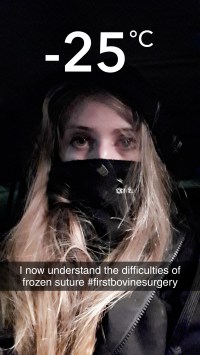
On the Thursday the vet and I went out to a large feedlot where they had two bloat surgeries for us to do. Depending on what cows are eating sometimes their stomachs can fill up with gas or bubbles and become really bloated! This can actually be lethal for a cow if the problem isn’t discovered and treated and prevented. If you are interested, this is a really good article from Alberta Agriculture about bloat. The vet did the first bloat surgery and then I did the second one. We were in a shed and there was a heat lamp but it was still so cold! Loosing feeling in your fingers, freezing suture, and frozen blood on the suture is a whole new level of difficulty. Very simply speaking, a bloat surgery puts a hole from the stomach of the cow to the outside world so they can safely release gas!

20180111_153444.jpg


This was a great placement! Despite it being cold and a little slow I felt that I gained a lot of knowledge (or topics to study up on) about the Canadian cattle industry and common diseases in feedlots. I appreciated a chat I had about being a practice owner and what that could look like–this is something I have always aspired to! Lastly, and not related to cattle…. I now know which little town to stop in and find the best peanut butter pie on the prairies!

Thanks again to all the wonderful vets and techs at VAHS!!

Snapchat-372637668


Small Animal Clinical Placement

Technically I haven’t started my 4th year of vet, but we are allowed to do a few weeks of placement this summer break so that we could have more flexibility or time off next year.

I shadowed several vets at Brandon Park Veterinary Hospital for two weeks. It is a small animal clinic.

One of my favourite things we did was an endoscopy on a dog who had a couple episodes of epistaxis. This means we put a very tiny (and expensive!) camera up his nostrils to check if we could see anything abnormal. Unfortunately there was nothing too obvious so we moved on to try and take some biopsies. Biopsies are little pieces of tissue that we send to a lab for further analysis– sometimes they can tell us if there is a microscopic problem.

This clinic did not do as many spays and neuters as I am used to in a general practice. However, one of the surgeries I observed was a mammary strip removal. Mammary tumors are common in female dogs who have not been de-sexed. The best way to help is to surgically remove the entire mammary gland and lymphatics on that side of the abdomen.

We did do a couple of de-sexing surgeries. I got to scrub in and do most of a canine castration one day.   The next day I did a cat castration! Right now, getting hands-on surgical experience is my favourite thing! I like it because it’s new, and a bit scary, but I learn new tricks or tips every time. During this surgery the surgeon showed me a specific way to place my suture material over my instruments to make the procedure flow more smoothly.

Small animal clinics do a lot of dental surgeries, and this clinic is no different. I was lucky enough to assist and do a few dental’s myself. Actually cleaning and probing the teeth is much more interesting than monitoring anesthetic during the dental surgery (at least for me). I have yet to do any extractions.

This clinic seems to always have students around; and for good reason! It is a great learning environment. There was a different year 10 (grade 10) student doing work experience there each week. I actually really enjoyed teaching them about the basic and common procedures we were doing. It was nice to be able to actually voice my knowledge in a summarized manner and explain WHY and HOW we do certain procedures. I think the students appreciated it too.

I was also able to run a couple consults myself. This included taking the history and doing the physical exam and vaccines on my own. The vet supervised and then covered up on the things I missed. This particular vet also taught me a lot about behavior cues we can pick up from the animals.

Actually, every doctor that I followed around had a bit of a ‘specialty’. One vet taught me a lot about behavior, another was very good at surgery, and another focused on internal medicine and ultrasound. I actually really like ultrasound. After 6 or so years of watching ultrasounds the black and white blobs are starting to look like actual organs.

When it was slower, one of the vets gave me some cytology slides to look at, or a case to work through and then go to the drug room and pick out some prescriptions for managing the pet. I quickly learned that I had to read the label of every product. Most things we learned about in class were single drugs, but I found that a lot of the drugs on the shelf were combinations. This was really good practice for me to start making connections in my brain.

Another doctor would find cool cases with blood work or test results to go through with me. We would sit down and he would tell me the clinical signs that the animal had and then I would tell him my differentials based on what I saw on the blood work.

This was really a lovely but relaxed placement! Sorry, no pictures this time!

I’m back home in Canada for my ‘summer vacation’.


Merry Christmas & Happy New Year…. see you in 2018!

Poutine, Emus, and Study Days

I very much admire the vet students who have managed to create regular blog posts throughout their semesters. I thought my second year was busy but my third year must have been busier because here I am writing my first blog post in over 6 months.

We have just finished our third year of classes and this only further confirmed how fast time can fly. Here is a quick run down of some of the most exciting/important things from the last few months:

I spent Canada day in Melbourne this year. Sometimes the weather in July here really makes ‘Christmas in July’ feel possible. Its often very rainy and windy. So I donned my Canada toque, met up with my cousin and one of my closest friends ( who thinks he is Canadian, but he’s not), and we ventured off for a day of fun. Its not my ideal Canada day–usually I look forward to some sunshine, a bit of dirt on my feet, and an escape from the city. This year we started the day off at a nearby pub. We had a maple imperial stout which was actually amazing…. but had a scarily high percentage! We may have also had two different kinds of poutine. Once we found out that not everyone was sure what a zamboni was we headed to the very busy skating rink in town to see if we had retained any skating skills. The next bar had ceasers…. disappointing…very disappointing. Federation Square was set up with red and white lights, Canadian flags, and a few spots of fake snow! We ended the night at the last bar which was a huge party with Tim Horton’s espresso martinis, life size cut outs of Justin Bieber, fooseball, plaid, and non-stop Canadian tracts. Oh… and more poutine.

We had a very exciting week in August.  We had our White Coat Ceremony at which we were all presented with our doctors coats. I was very blessed to have a family member— my cousin (who is currently living in AUS) at the ceremony. This day signaled our official transition from pre-clinical study (lectures and textbooks and exams) to clinical studies (working in hospitals, hands-on, practical assessments).

Then a few days later I got to wear that shiny new coat to complete one of my first surgeries. My roommate and I worked together to spay a lovely greyhound–who happened to be my other roommate’s dog! The surgery went very well and we still see the dog often which is so nice! I was much less nervous for this surgery than my last one which was very refreshing! We had multiple papers to read, videos to watch, and a tutorial on medical models the week beforehand.

On my spring break I planned a quick camping trip out to the Grampians for 2 nights!  I’ve been wanting to camp in this park since my first year in Australia. Other than an annoying detour  the trip was fantastic. We went hiking both days, wandered the town, stopped for ice cream, hid from the rain, and saw kangaroos, an echidna, and even emus! How crazy is it that I am seeing WILD EMUS. I would love to come back to the Grampians for a week in the summer and do more hikes and hopefully find a couple of swimming holes.

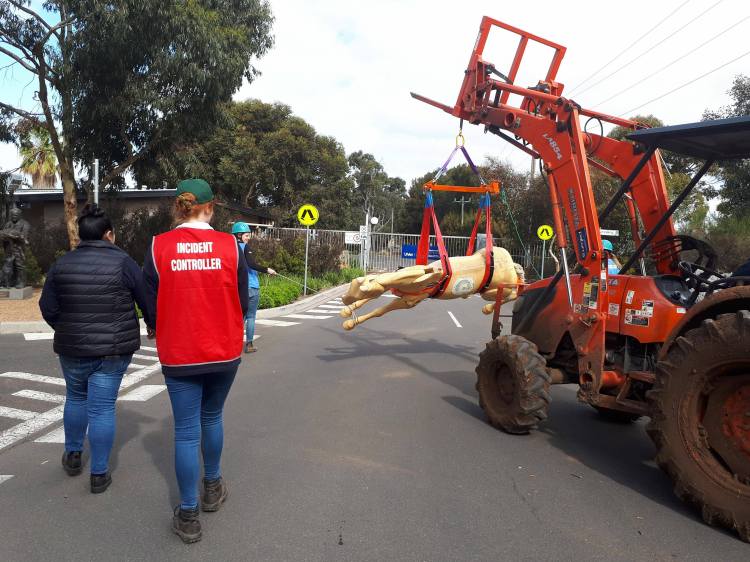
Another very cool thing I did this past semester was participate in a 1 day large animal emergency rescue course. We mostly talked about horses but the techniques are applicable to cattle and other large livestock animals. The day was a mix of lectures and hands on. We learned how to make our own darts for medication, how to organize and run an emergency incident site, and practiced safely restraining horses from a variety of difficult situations.  They day concluded by rescuing a (model) horse from a dam.

rescue

‘Bruce’ the model horse, just moments after our team coordinated his recovery from the dam

And finally, my last exam period. We had 6 finals this time. These are my classes:

  1. Cats & Dogs
  2. Principles of Professional Practice
  3. Horses
  4. Cattle
  5. Small Ruminants (mostly sheep and goats… with a few llamas and deer thrown in)
  6. Birds

(How cool is that!?)

At the University of Melbourne we have 1 week off before the exams begin. My alarm went off at 7am every morning and I used a timer to keep myself focused during the long hours and days. Finals were just as enjoyable as usual…..but with that I’m done my 7th year of university and am looking forward to the final year in my vet school journey.

Next year will be all placements and rotations. I get to book some of them myself–at practices that I am interested in working at or curious about the cases. The other rotations are administered by the university. I have a lot of high expectations for next year. I expect it to be challenging, exciting, and quite a growing experience.

study

I have a new study buddy. She showed up most mornings at about 7:30am to sleep on my bed until she headed downstairs for dinner around 5pm.